Delphi
The Drover's WifeDelphi, the young daughter of Molly Johnson, is portrayed through the ordinary textures of childhood—singing, games, clothes passed on through charity, and a rag doll—set against the instability and danger surrounding her family. Her first separation from Molly and the later threat of official removal show how a child’s attachments can be placed at risk both by the natural world and by colonial authority.
Identity and Everyday Life
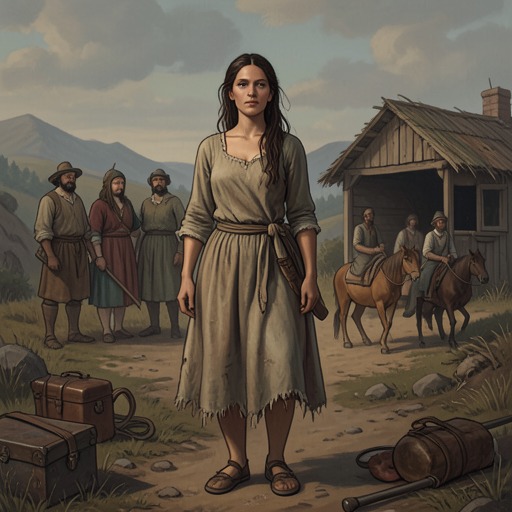
Delphi is one of Molly’s children and the younger sister of Danny and Joe Junior. Molly’s care is visible in the small work she puts into her daughter’s appearance: she sets Delphi’s naturally curly hair in ringlets using strips of old bed sheets. Delphi wears a faded pink skirt from one of Miss Shirley’s annual Christian charity clothing packages; it is still too large, and a safety pin holds it together. These details locate her childhood within material scarcity, while showing the attention Molly gives her despite it.
Delphi sings to herself in a clear soprano and skips ahead without apparent concern. Molly contrasts this ease with her own lifelong habit of worrying, while noting that Danny is quick to notice when she is troubled. The contrast does not make Delphi unaware of hardship in general; rather, it captures a particular moment in which her mother has managed to preserve a little room for carefree childhood.
Play and the Mountain Flood
During a family stop beside the river, Delphi occupies herself at the water’s edge with her rag doll, making mud cakes for an imagined tea party. She is absorbed in the game and does not initially understand that the river is rising. As the cakes begin to wriggle, she tries to restore their shape, treating the changing mud as part of play before recognizing that something is wrong.
The current carries her doll away in the murky floodwater. Delphi turns to Danny and points out the floating toy, calling for his attention. Her small, immediate loss is also the first clear warning the children receive of the river’s danger. Molly, asleep nearby, wakes as the roar grows; when she sees the swollen river carrying a boulder more than six feet high, she pulls Delphi away from the edge and directs her farther up the bank. The episode places Delphi’s imaginative world at the threshold of a danger she cannot yet interpret, while showing how quickly Molly’s protective attention becomes decisive.
Family Attachment and Separation
Delphi’s bond with Molly is especially clear when the children leave in the covered wagon with the Clintoffs. She has never been away from her mother before and is upset, though the promised adventure and the prospect of returning to a new baby brother or sister help temper her sadness. Before the journey, she clings to Molly for an extra-long moment. The farewells make separation tangible: the children carry parcels of food and clothing, while Molly kisses and embraces them and tells them she loves them.
Molly’s gestures create a family ritual of continued connection. She uses a clenched fist, releases a breath through it, and whispers, “Always with you.” Delphi’s first absence from home is therefore framed not as a severing of affection but as a separation the family tries to bridge with care, reassurance, and the expectation of reunion.
The Removal Threat
Delphi later becomes one of the children threatened by a judge’s authorization for removal. Miss Shirley urges the intervention by classifying the children as “Octaroon” and presenting them as needing help. The judge signs the authorization, and Danny learns of it before returning to Molly. When he tells her that Miss Shirley called them “octaroons,” Delphi is included in the racial category being used to justify taking the children from their mother.
Molly recognizes the danger in the word from her own childhood. At eight, she had overheard Miss Shirley discuss sending a mixed-heritage child away, and she now understands that the same logic is being applied to her children. The threat thus connects Delphi’s immediate family life to the racial classification and coercive child-removal practices that shaped Molly’s past. The evidence does not describe Delphi’s individual response to the order; instead, it shows the stakes through Danny’s report and Molly’s recognition of what the classification permits.
Molly’s Resistance and Delphi’s Place in the Story
Molly finds Miss Shirley and Father McGuinness bound in their home and confronts Miss Shirley over claiming to know what is best for her children. She then burns the authorization, destroying the written terms that call for the children’s removal. The decision gives material force to Molly’s refusal: the document’s official language cannot be separated from the family it threatens to divide.
Delphi’s role is not that of an agent in the legal conflict; she is among the children whose safety and kinship are being decided by adults. Her earlier play with the rag doll and her prolonged farewell to Molly establish the particular human attachments obscured by bureaucratic labels. Across these scenes, the doll, the journey, and the signed paper mark contrasting conditions of childhood: the fragile freedom to play, a temporary separation held together by family care, and the danger of a separation imposed by colonial authority.